Press Kit
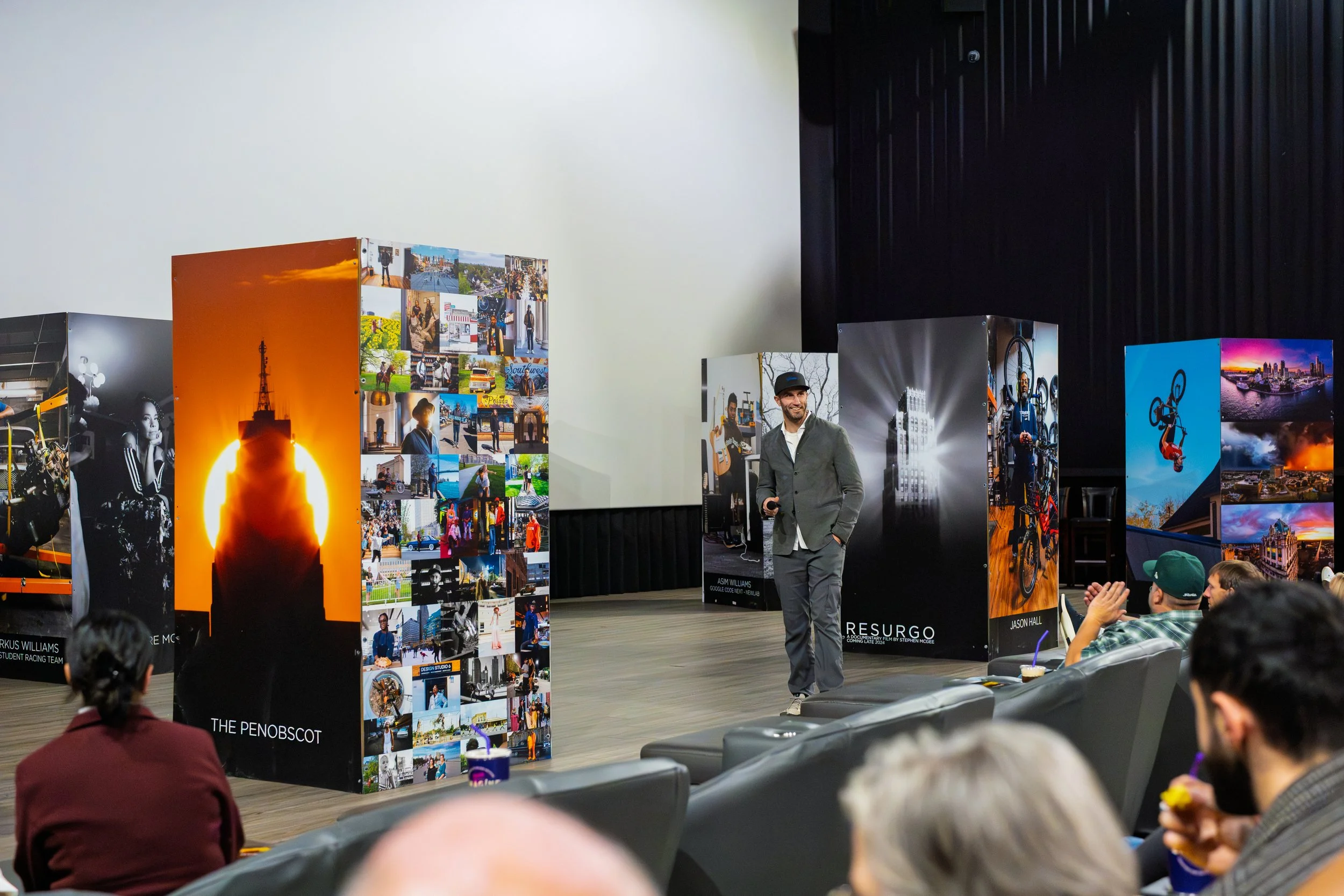
Resurgo played a sold out test screening in Royal Oak. The photographs are part of a traveling photography installation by Stephen McGee promoting the film.
Photographs and Posters from Test Screenings
Resurgo: The Rise from Within is a landmark documentary from director Stephen McGee and poet-producer Jessica Care Moore, created from twenty years of immersive filmmaking in Detroit. Drawing from millions of photographs and thousands of hours of footage, the film rejects the decades-old national narrative of Detroit as a symbol of decline. Instead, it presents a powerful, people-centered portrait of a city defined by creativity, endurance, and humanity. Through intimate storytelling, poetic narration, and stunning cinematography, Resurgo reframes Detroit for both longtime residents and global audiences, offering a truer and more dignified reflection of the city’s soul.
The documentary has generated exceptional audience response and critical momentum. Resurgo won Best Feature Film at the Fresh Coast Film Festival and has been recognized by reviewers for its emotional honesty, visual depth, and social relevance. Screenings across Michigan have consistently sold out or neared capacity, often ending in standing ovations and extended Q&A sessions, many lasting an hour or more, with audiences fully engaged until the final moment. Each event has sparked meaningful conversation about Detroit’s identity and the importance of narrative ownership, underscoring the film’s cultural and community impact.
As word spreads, Resurgo is rapidly becoming a catalyst for renewed civic pride and broader national attention. Viewers frequently describe the film as transformative,reshaping their understanding of Detroit and revealing stories rarely seen in mainstream media. With its blend of historical archive, artistic voice, and lived experience, Resurgo is not only documenting a city’s evolution but contributing to it. The project stands poised to influence how Detroit is perceived for years to come, marking it as one of the most significant and emotionally resonant films to emerge from the region in decades.
University of Michigan Write Up
In 2005, filmmaker Stephen McGee accepted an invitation to move to Detroit, sight unseen.
It was the first of many life-changing invitations he would accept while living in the city. And each of those invitations brought him closer to creating something he hoped “would move the needle toward a better tomorrow.”
Stephen McGee. (Image credit: Resurgo/TheDetroitFilm.com.)
A job at the Detroit Free Press brought the San Francisco native here, but after two years with the paper (and two national Emmys for cinematography), he struck out on his own in search of deeper stories from the street level.
“Detroit was very much dominated by an outside narrative, and not a lot of inside storytelling was making it to a national audience,” McGee says.
Some 19 years, 3 million photographs, thousands of hours of footage, and hundreds of freelance pieces later, the onetime outsider found his way in, block by block. And in his ambitious documentary “Resurgo: The Rise from Within,” he invites viewers to join him. Jessica Care Moore, artist, activist, and Detroit’s poet laureate, produced the film.
“As a native Detroiter, I’ve been a fan of Stephen and Jessica Care Moore for years,” says the institute’s Shaunda Bunton, assistant director of public programming and engagement. “Detroit’s history is American history. Its culture is bold, diverse, and rich. I was inclined to invite Stephen to campus because of his unique approach to storytelling. ‘Resurgo’ amplifies the voices of people who live, work, and cherish the city, who offer an informed critique of Detroit. Viewers can expect authenticity.”
People, places, pillars
Detroit filmmaker Stephen McGee amid a series of photo pillars featuring his immense archive. See more on Instagram.) (Image courtesy of Resurgo/TheDetroitFilm.com.)
At the Institute for the Humanities event Jan. 29, McGee will be joined by one of the film’s subjects, Raymond ‘SouFy’ Elwart, an Anishinaabe hip-hop artist, dancer, and community leader with deep knowledge of the city’s Anishinaabek heritage.
“Detroit is full of characters who should be global names,” McGee says.
He celebrates those characters in the institute’s exhibition “Pillars,” so named for the 32 eight-foot-tall pillars representing McGee’s extensive photo archive. Portraits of local leaders, artists, and personalities — from SouFy and Grace Lee Boggs to Miguel Cabrera and Ben Wallace — are featured. Architectural icons and historic events also appear: the Penobscot Building, Red Wing Steve Yzerman walking the Stanley Cup down Woodward Avenue, and creation of the RoboCop statue.
The event is organized by the 2025-26 Public Humanities Interns.
“Throughout my time here, I kept on being invited into strategic parts of the city’s change, kind of like ‘Forrest Gumping’ my way through history,” the artist says. “And in those meetings instead of trying to define Detroit in a catchy way I would just point to the people, point to the people, point to the people.”
As a result, McGee developed trust with the city’s high-placed politicians, CEOs, billionaires, leaders of foundations, and more. Local viewers will recognize names like Mike Duggan, Big Sean, Jack White, Bill Ford, and many others.
“I started stacking this very diverse lens that you wouldn’t be able to do if you didn’t have the connections I had inside all these organizations,” McGee says. “‘Resurgo’ is a lens that invites people into the city as I was invited in, where they might not have seen themselves otherwise.”
Right place, right time
McGee’s own backstory set him up well for such a mission. He’s filmed in 40 countries, including war-torn Uganda, Angola, Rwanda, Vietnam, and Cambodia, where he witnessed profound human resilience amid heartbreaking devastation. For pleasure, he visited some of the world’s most famous ruins: the Acropolis, the Parthenon, the Pantheon, and the Great Pyramids.
“In Detroit, I felt instantly ingrained into a culture that I felt I’d seen around the world, but this was in the United States,” McGee says. “And it was this idea of: ‘These aren’t ruins because of a 313 area code. This is maybe a larger picture of something that our country’s not even discussing.'”
The immersive documentary has generated exceptional audience response and critical momentum. View the Resurgo trailer, read the film synopsis, and buy tickets/submit questions for the screening.
A narrative arc crystallized over time as he completed major projects for such clients as the Ford Motor Co. and the Kresge Foundation. In 2015, he collaborated on a film that helped Detroit earn its status as a UNESCO city of design. In 2016, he worked on a film with local rap artist Big Sean. In 2017, he collaborated on a movie designed to woo Amazon’s headquarters to the Motor City.
More recently, he documented the rebirth of one of the most iconic urban ruins in the nation: Ford’s renovation of the Michigan Central Station. His photos hang in the public spaces on the building’s first floor, and he also produced a book about the renovation in collaboration with Bill Ford.
“It’s like every single year during that stage of Detroit’s history was like 10 years of any other city,” McGee says. “Not only could you see the rapid growth happening in the financial sector, but you saw the national narrative switch and begin to parallel the narrative that had always been inside the core of the people.”
‘My city’
Local screenings
Bamboo Grand Rapids: Feb. 26
Farmington Hills Film Festival: March 7
Emagine Royal Oak: Feb 19, March 5,
Fresh Coast Film Festival, Traverse City: May 2
In 2013, McGee purchased a $1 house in the shadow of the train station where he and his wife, a competitive BMX rider for Team USA, are raising their three daughters. The abandoned home he renovated was once featured on the front page ofThe New York Timesbecause someone had painted “The Dream is Now” on the building.
These days in Detroit, “nobody talks about dreams. They just do,” McGee says. “Our country is turning 250; what’s happened here for the past 20 years makes me believe in it still.”
McGee is planning a 30-city tour targeting the “Detroit diaspora” nationwide and hopes to produce a follow-up documentary and book, among other possibilities. He has entered “Resurgo” into the Tribeca Film Festival, Mountainfilm, and Cannes Film Festival and is preparing for a potential run at the Academy Awards. The world premiere date is yet to be determined.
With its blend of historical archive, artistic voice, and lived experience, “Resurgo” is not only documenting the city’s evolution but contributing to it.
“I have enough for a 10-part series,” McGee says, “and if I don’t put everything into bringing the voices that have opened their lives to me to the world, then I haven’t served my city.”
He swivels in his chair to look at the sparkling windows of Michigan Central.
“Ah, look,” he says. “The sunshine is coming in.”
Synopsis 2
Resurgo is a ground-level epic twenty years inside an American city most people thought they already understood. Told through the eyes of a war-trained photojournalist who arrived in Detroit sight unseen in 2005, the film unfolds as a personal reckoning, a civic archive, and a quiet warning to the rest of the country.
Moving fluidly between intimate family life and history-shaping moments, Resurgo traces Detroit through bankruptcy, abandonment, and rebirth, not as a comeback story, but as a human one. From the ruins of Michigan Central Station to its resurrection, from a $1 house across the street to boardrooms, block clubs, classrooms, and kitchen tables, the film captures a city narrated from the inside out. The camera becomes a witness to moments few were invited into: financial collapse, cultural triumph, political reckoning, and the relentless labor of community survival.
Anchored by poet laureate and producer Jessica Care Moore, and carried by voices that span neighborhoods, generations, and ideologies, Resurgo resists simple heroes. Billionaires are present, but never centered. Celebrities appear, but only as citizens. What endures are the people, artists, farmers, elders, children, who held the city together when systems failed, and whose stories were rarely recorded.
As Detroit’s narrative begins to shift, the film widens its gaze, drawing unsettling parallels between the Rust Belt and today’s “Tech Belt.” Cities once confident in endless growth now echo Detroit’s past, raising urgent questions about disinvestment, belonging, and what happens when communities are treated as disposable. Detroit, the film suggests, may be fifteen years ahead—not behind.
At its core, Resurgo is a story of love and loss, of an outsider learning when to listen, and of a city that never stopped believing in itself, even when the nation did. It is not a blueprint, but a mirror: a reminder that resilience is not abstract, renewal is not clean, and the future of American cities may already be written in the places we once called ruins.